"Medical costs are the tapeworm of American economic competitiveness"
Warren Buffet
A 2026 study released by Morgan Health(opens in new tab) (a division of JP Morgan,) noted that small-and mid-sized businesses (SMBs), which employ about half of the U.S. workforce, are facing median reported premium increases of 18%.
Key findings:
- 30% of SMBs (< 50 employees) report that health insurance costs are worsening their business situation
- 71% of SMBs have taken steps to respond to rising costs, such as implementing wellness programs, reducing spending elsewhere, or shifting costs to employees
Reducing Costs: According to Physicians for a National Health Care Program(opens in new tab), companies would pay less under a single-payer system than they currently pay.
Businesses are a key component in our health care system. Health insurance companies expect businesses to pay hefty fees for "high-quality" individual policies. The result: record profits for the insurance industry, reduced access to care, and more than 40% of individuals with commercial insurance have high-deductible plans, which effectively means they only have catastrophic care.
According to the National Federation of Independent Business, a staggering 98% of small business owners(opens in new tab) project that in the next 5-10 years they will no longer be able to offer health care benefits to employees.
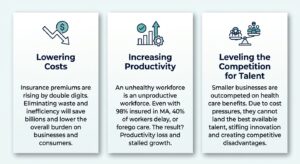
A single-payer health care system would emlinate waste, contain costs and ensure that all employees are given comprehensive care with no volatility, or administrative burden.
Businesses would pay less at a fixed rate, and productivity could increase with a healthy work force.
Calculate the potential savings for your business.
Small-business health insurance market facing "death spiral"